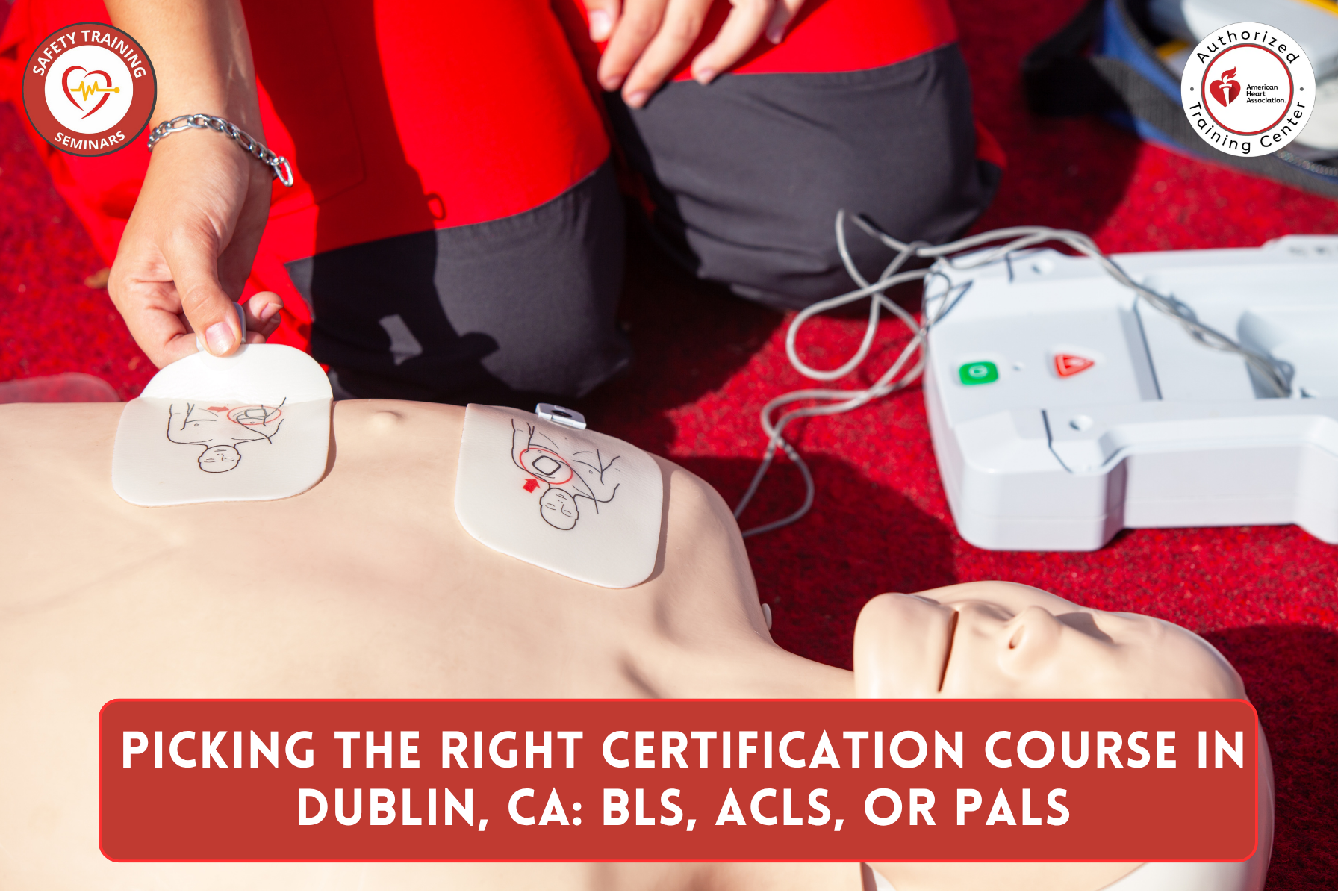
A new healthcare job, clinical rotation, or renewal requirement can leave Dublin professionals comparing three similar acronyms: BLS, ACLS, and PALS. They are related, but they serve different purposes. BLS covers the core CPR, ventilation, and AED skills used across healthcare settings. ACLS builds on those skills for serious adult cardiovascular emergencies, while PALS focuses on emergency care involving infants and children.
The right course depends primarily on what your employer, school, or clinical program requires and the patients you may be responsible for treating. Instead of choosing the course that sounds most advanced, start with the exact credential listed on your paperwork.
Key Takeaway: BLS is the foundation for many healthcare roles. ACLS extends that foundation into advanced adult cardiovascular care, while PALS is designed around pediatric emergencies. Dublin learners should confirm the required credential before registering.
Start With the Requirement, Not the Course Name
The simplest way to narrow your choices is to read your employer or school requirement word for word. If it specifically says BLS, do not assume that a general CPR course automatically satisfies the same requirement. If ACLS or PALS is named, register for the requested course rather than choosing based on familiarity.
The American Heart Association identifies its BLS Provider Course as appropriate for healthcare professionals, trained first responders, and people enrolled in healthcare training programs. It also recommends checking with your employer to make sure you are selecting the correct course.
Your job title alone may not provide the answer. Two nurses, for example, could have different training requirements because one works primarily with adult patients while another works in a pediatric or emergency-care setting.
That is why the organization asking for your credential should be your first source of guidance.
What BLS, ACLS, and PALS Actually Add to Your Training
Understanding the scope of each course makes it easier to see why some healthcare professionals need one credential while others may need two or three.
BLS: Core Healthcare Resuscitation Skills
Basic Life Support teaches healthcare providers how to recognize life-threatening emergencies and perform skills that include high-quality CPR, ventilation, and early AED use. The AHA offers BLS training for both in-facility and prehospital environments.
For someone searching for a BLS CPR Certification Course, the important point is that BLS is not simply a less advanced version of ACLS. It provides the foundational resuscitation skills on which advanced cardiovascular training builds.
A Dublin nursing student, medical professional, or healthcare trainee should therefore check whether “BLS for healthcare providers” is specifically listed in their program or employment requirements.
Learners comparing locations east of Dublin can also review CPR, BLS, ACLS, and PALS classes in Livermore when considering their training options.
ACLS: Advanced Care for Adult Cardiovascular Emergencies
Advanced Cardiovascular Life Support builds on BLS and is designed for healthcare professionals who direct or participate in managing cardiac arrest, stroke, and other cardiopulmonary emergencies. The AHA identifies emergency response, emergency medicine, intensive care, critical care, and surgery among the settings where ACLS may be relevant.
That makes ACLS more appropriate when a provider’s responsibilities go beyond initial CPR and AED use and extend into advanced adult emergency management.
If your new position requires ACLS, check whether BLS is also listed separately. An advanced credential should not automatically be treated as a replacement for another requirement.
PALS: Advanced Emergency Care for Pediatric Patients
Pediatric Advanced Life Support changes the patient focus. PALS is intended for healthcare professionals who respond to emergencies involving infants and children, including providers working in emergency medicine, emergency response, intensive care, and critical-care settings that regularly encounter pediatric patients.
The training addresses pediatric respiratory emergencies, shock, arrhythmias, and cardiopulmonary arrest, along with coordinated team response.
A provider should therefore select PALS because pediatric emergency care is relevant to the role or because an employer or clinical program requires it—not simply because PALS is considered advanced training.
Match the Course to a Real Clinical Situation
Thinking about job responsibilities often makes the decision clearer.
A nursing student starting clinical rotations may receive paperwork requesting BLS for healthcare providers. In that case, taking ACLS without first checking the school’s requirement could add training that was never requested.
A clinician moving into an adult emergency or critical-care position may find both BLS and ACLS on the onboarding checklist. The correct step is to confirm each requirement rather than assuming ACLS covers everything.
A healthcare professional who regularly treats seriously ill children may be asked to complete PALS because pediatric emergency recognition and intervention are relevant to that role.
These are examples, not universal rules. Employers, healthcare facilities, schools, and clinical programs can set different requirements.
Professionals whose work or commute takes them toward the western East Bay can also compare Hayward CPR and advanced life support classes before deciding where to complete their required training.
Check the Course Format Before You Enroll
Knowing that you need BLS, ACLS, or PALS is only part of the enrollment decision. You should also verify the specific course format your organization expects.
For example, the AHA offers BLS as either classroom training or blended learning, where online coursework is followed by a hands-on skills session.
Before registering, confirm:
- The exact credential listed by your employer or school
- Whether you need an initial course or renewal
- Whether pre-course work or prerequisites apply
- What documents or materials you should bring
- Whether your organization has specific course-format requirements
Do not assume an online-only credential will satisfy every employer, school, or licensing requirement. If the instructions you received are unclear, ask the organization requesting the training before enrolling.
This small verification step can prevent choosing the right subject but the wrong course format.
Planning Certification Training Around Dublin and the East Bay
Healthcare workers and students in Dublin often have to fit certification training around work, school, clinical placements, and travel within the East Bay. Someone living in Pleasanton may consider Dublin first, while learners traveling from Castro Valley, San Leandro, or Union City may compare several locations.
Course fit should still come before geography. A nearby class is useful only when it matches the credential your organization expects.
For professionals whose schedule regularly takes them farther south or west, Fremont CPR and healthcare certification courses provide another supplied location option to review.
Rather than choosing a location and then asking which course is available, reverse the process: identify the required certification first, then find the location that offers an appropriate option for your plans.
Taking the Next Step With Safety Training Seminars in Dublin
Safety Training Seminars offers healthcare certification course options in Dublin at 7567 Amador Valley Blvd, Suite 102, Dublin, CA 94568. Current business and course information lists BLS, ACLS, and PALS among the training options available at the Dublin location.
For nurses, healthcare students, clinical professionals, and others completing work or school requirements, the practical next step is to compare the appropriate course description with the exact credential requested by your organization.
If Dublin does not fit your travel plans, you can also review CPR, BLS, ACLS, and PALS classes in Newark as another supplied location.
Whichever location you consider, verify the course type and current registration details before enrolling.
Frequently Asked Questions
Should a Dublin nursing student take BLS, ACLS, or PALS?
Start with the nursing program’s written requirement. BLS is designed for healthcare professionals and people enrolled in healthcare training programs, while ACLS and PALS address more advanced adult and pediatric emergency care. If the program does not clearly identify the required course, ask the clinical coordinator before registering.
Does having ACLS mean I no longer need BLS?
Do not assume so. ACLS builds on BLS skills, but an employer or clinical program may list the credentials separately. Follow the specific requirements provided for your position and confirm with the organization if you are unsure whether both are required.
Can I take PALS if I already have ACLS?
Yes, because the courses focus on different clinical situations. ACLS addresses advanced adult cardiovascular emergencies, while PALS focuses on emergencies involving infants and children. Whether you actually need both depends on your patient population and employer or program requirements.
Will an online BLS course meet my employer’s requirement?
Not necessarily. The AHA offers blended BLS training that combines online coursework with a hands-on skills session, but individual employers, schools, and licensing organizations may have their own acceptance requirements. Confirm the required format before enrolling rather than assuming all online options are equivalent.
Can someone from Pleasanton or Union City take a course in Dublin?
Learners can compare training locations based on where they live, work, study, or complete clinical placements. The important issue is whether the course offered matches the certification requirement. Before traveling to Dublin, review current course information and confirm the credential you need with your employer or school.
Choose the Course That Matches Your Professional Responsibility
BLS, ACLS, and PALS are connected, but each serves a distinct purpose. BLS develops core healthcare resuscitation skills, ACLS extends those skills into advanced adult cardiovascular emergencies, and PALS focuses on serious pediatric emergencies.
For healthcare professionals and students in Dublin, CA, the strongest starting point is not the most advanced course name—it is the exact requirement provided by your employer, school, or clinical program. Confirm that requirement first, especially if more than one credential appears on your checklist.
Safety Training Seminars provides local training options for Dublin learners. Once you know which credential you need, review the current course type and registration information for the appropriate location before enrolling.